Tungsten Carbide Mold & Die Material Selection Guide

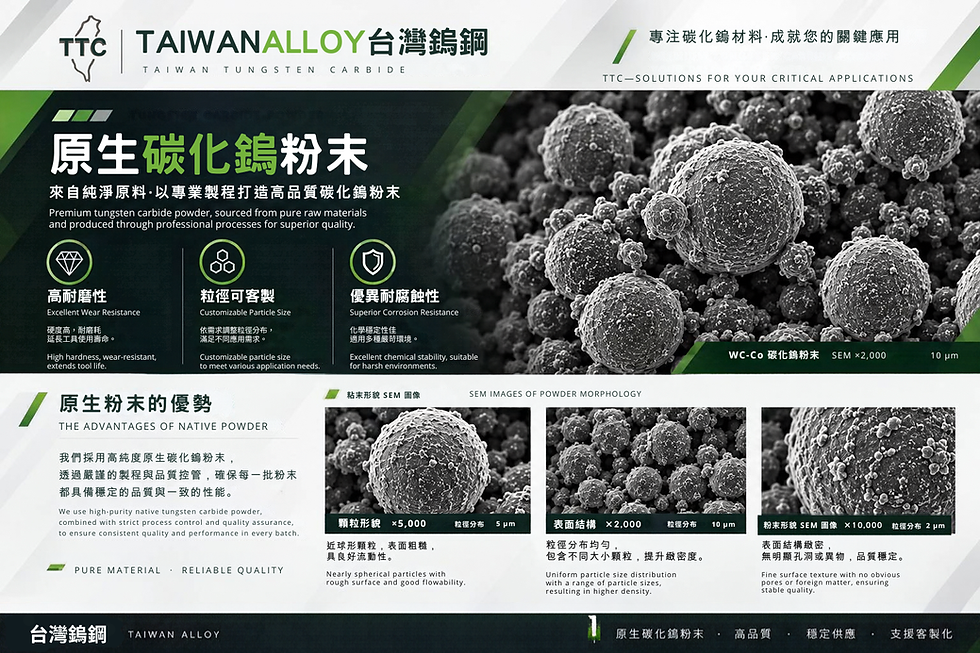
When clients consult us with their current material grades, Taiwan Tungsten Carbide evaluates and optimizes selection through three core diagnostic dimensions:
1. Diagnosing Real-World Mold Failure Modes
Normal Wear & Tear: Indicates sufficient toughness. We recommend fine-grain carbide structures to further enhance wear resistance and service life.
Chipping or Transverse Fracture: Signals a severe lack of fracture toughness in the current grade. This requires a high-purity matrix structure to significantly improve impact resistance.
2. Clarifying Actual Operating Conditions
We evaluate the workpiece material (carbon steel, stainless steel, or alloy steel) alongside the dynamic impact severity of the application to recommend the most suitable impact-resistant grade.
3. Prioritizing Purity & Density Over Basic Chemical Matching
Budget materials from other suppliers may match the cobalt content and hardness of premium grades on paper. However, if manufactured with low-grade recycled powders, internal microporosities become critical failure points that compromise toughness.
Our Core Manufacturing Standards
To ensure our tungsten carbide materials deliver outstanding fracture toughness, Taiwan Tungsten Carbide adheres strictly to three core manufacturing processes:
100% Premium Virgin Powder: We enforce a strict zero-recycled-powder policy. Eliminating secondary or scrap powders ensures absolute raw material purity and removes micro-stress concentration points at the source.
CIP (Cold Isostatic Pressing): Using uniform fluid hydrostatic pressure, CIP eliminates density gradients and internal stresses typical of conventional uniaxial pressing, ensuring uniform structural strength.
Sinter-HIP (Pressure Sintering): High pressure is applied during high-temperature sintering to completely eliminate internal microporosities. This achieves near-theoretical density and exceptional fracture toughness, preventing crack propagation under high impact.


Comments